
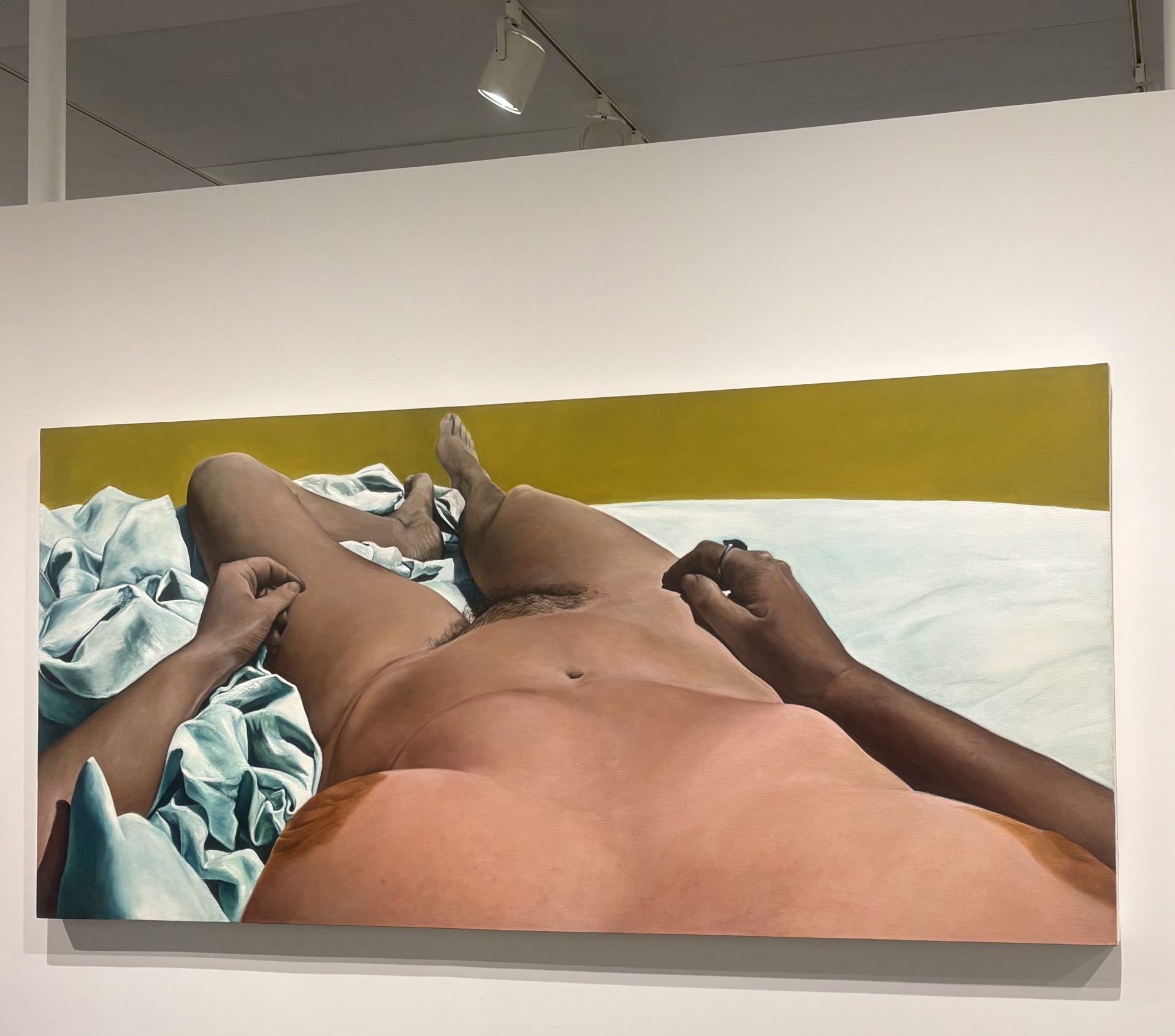
Through the Object’s Eye, 1975. Oil on canvas. Courtesy of Alexander Gray and Associates.
Upon my first visit to Joan Semmel: In the Flesh, I found it almost vulgar. Frankly, I was surprised to see such graphic nude art shown at a museum highly trafficked by families with young kids. I had never been confronted with images of aging naked bodies so unapologetically; Semmel’s body of work felt invasive in its honesty. A few months later, I returned to the same exhibition, having researched Semmel and her significance in the canon of feminist art. I began to appreciate Semmel’s insistence on visibility of the aging female body, as she thoughtfully transformed her subjects into something profoundly human.
The show is arranged chronologically, allowing for the evolution of Semmel’s technique to be both accessible and compelling. Although I am generations removed from Semmel’s own, I could easily track the maturation of her style through the decades. While her central concern, female embodiment, remains remarkably consistent, the visual language through which she explores this theme shifts over time. Her earlier work feels as though she is setting the ground rules, while later paintings increase in confidence and freedom of expression.
WHAT: Joan Semmel “Joan Semmel: In the Flesh”
WHEN: 12 DEC 2025 – 31 MAY 2026
WHERE: The Jewish Museum 1109 5th Ave (92nd St), New York NY
Semmel’s stylistic progression also reflects the artistic and cultural climate of each era, revealing how she simultaneously worked within and against the conventions of her time. Considering her paintings alongside her contemporaries made Semmel’s radical honesty even more apparent to me.
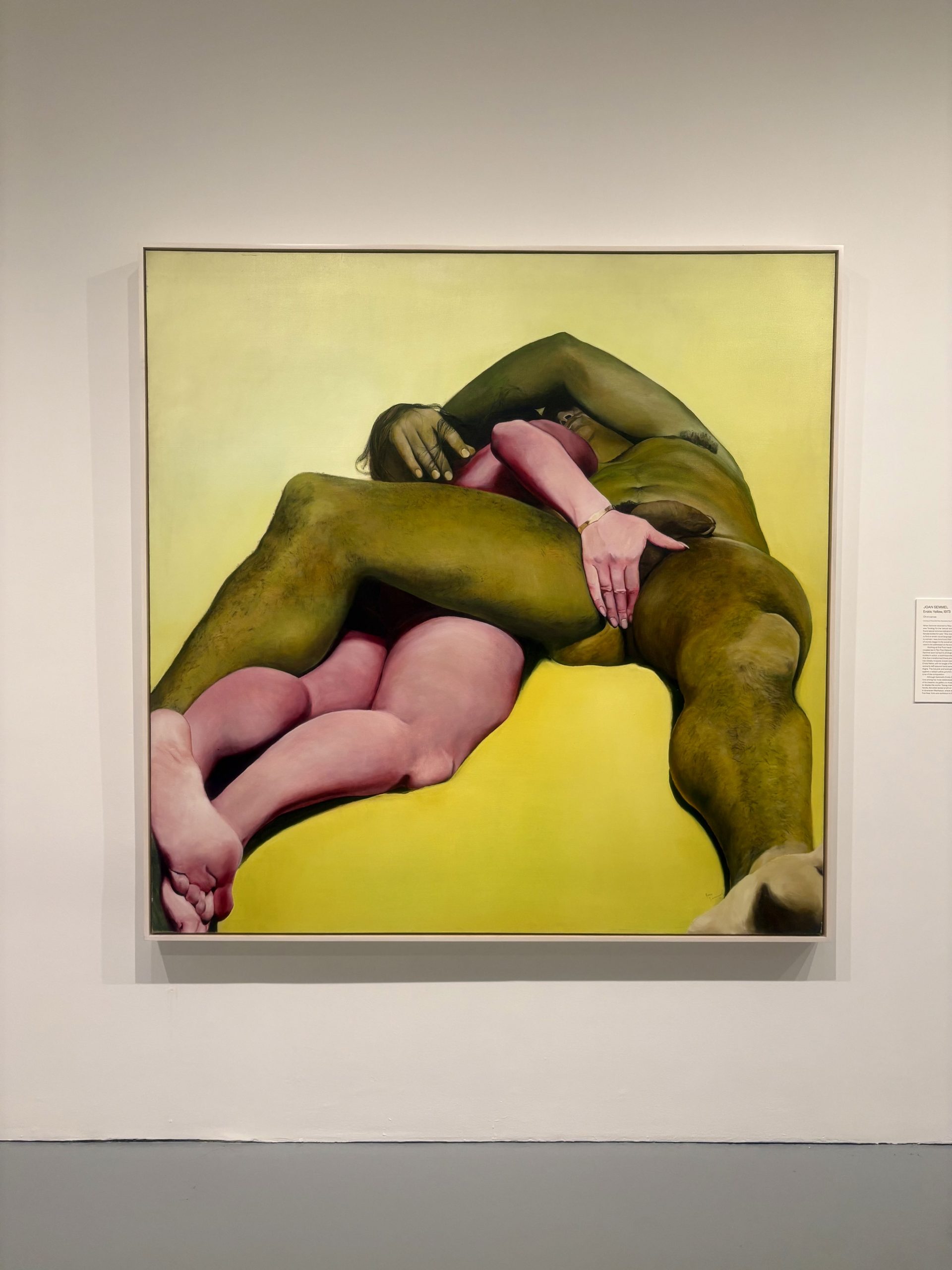
Erotic Yellow, 1973. Oil on canvas. Courtesy of Alexander Gray and Associates.
Among the selected works, many portray the nude female body either at rest, in solitude, or engaged in intimate sexual encounters. Semmel seeks to represent pleasure through the female perspective rather than through the traditional male gaze. Color and movement become tools to communicate sensation. In Erotic Yellow (1973), two bodies lay together, intertwined intimately against a controlled yellow backdrop. The woman is hot pink, while the man is muted green, as though pleasure is emanating directly from the woman’s body. The contrast makes her presence feel electric, allowing the woman’s desire and vitality to dominate the composition. According to the wall text, at the time of its creation, no gallery or museum was willing to display this work, revealing how radical the unapologetic representation of female sexuality was during that era.
What makes Semmel’s work especially powerful is its rejection of the so-called “ideal” female body. Her paintings show bodies at rest, bodies in private, bodies aging. They are “unideal” only because society has trained the human eye to see them that way. Semmel directly challenges the perception of the female aging body as a taboo, confronting the historical disdain for folds, creases, wrinkles, pubic hair, sagging skin, and other visible signs of age. Rather than disguising these features, she emphasizes them. Semmel transforms what is often hidden into something unapologetically visible, making this taboo impossible to ignore.
Semmel’s honesty separates her from many male painters of her generation. Historically, women’s bodies in art are polished into fantasy-level perfection: hairless, passive, and anatomically distorted to suit ideals of beauty. Semmel refuses that tradition entirely. Details as simple as the presence of pubic hair became significant, as feminist artists of Semmel’s generation understood that realistic representations of women’s bodies mattered. They insisted that these features were not flaws but natural byproducts of being alive. In this sense, Semmel’s paintings feel almost archival, preserving bodily realities that art history erased altogether.

Sunlight, 1978. Oil on canvas. The Jewish Museum, New York.
Thematically, Semmel ponders the question of what it means to be in a body. Through her 1978 oil on canvas, Sunlight, she expresses this philosophical wonderment. According to the wall text, Semmel once said, “I wanted the sensual feeling of how one experiences the body rather than just how one sees it in the mirror.” Instead of presenting the body as an object to be observed from the outside, Semmel paints from the perspective of inhabitation. In Sunlight, the viewer is positioned within the body itself, experiencing fragmented limbs, shifting light, and intimate angles that mimic human perception.
Throughout the exhibition, Semmel repeatedly balances individuality with universality. In some self-portraits, like Sunlight, jewelry such as a ring appears, reminding viewers that this is not simply every woman, but Joan Semmel specifically. At the same time, her work speaks broadly to womanhood and bodily experience. There is a push and pull between personal identity and collective representation.
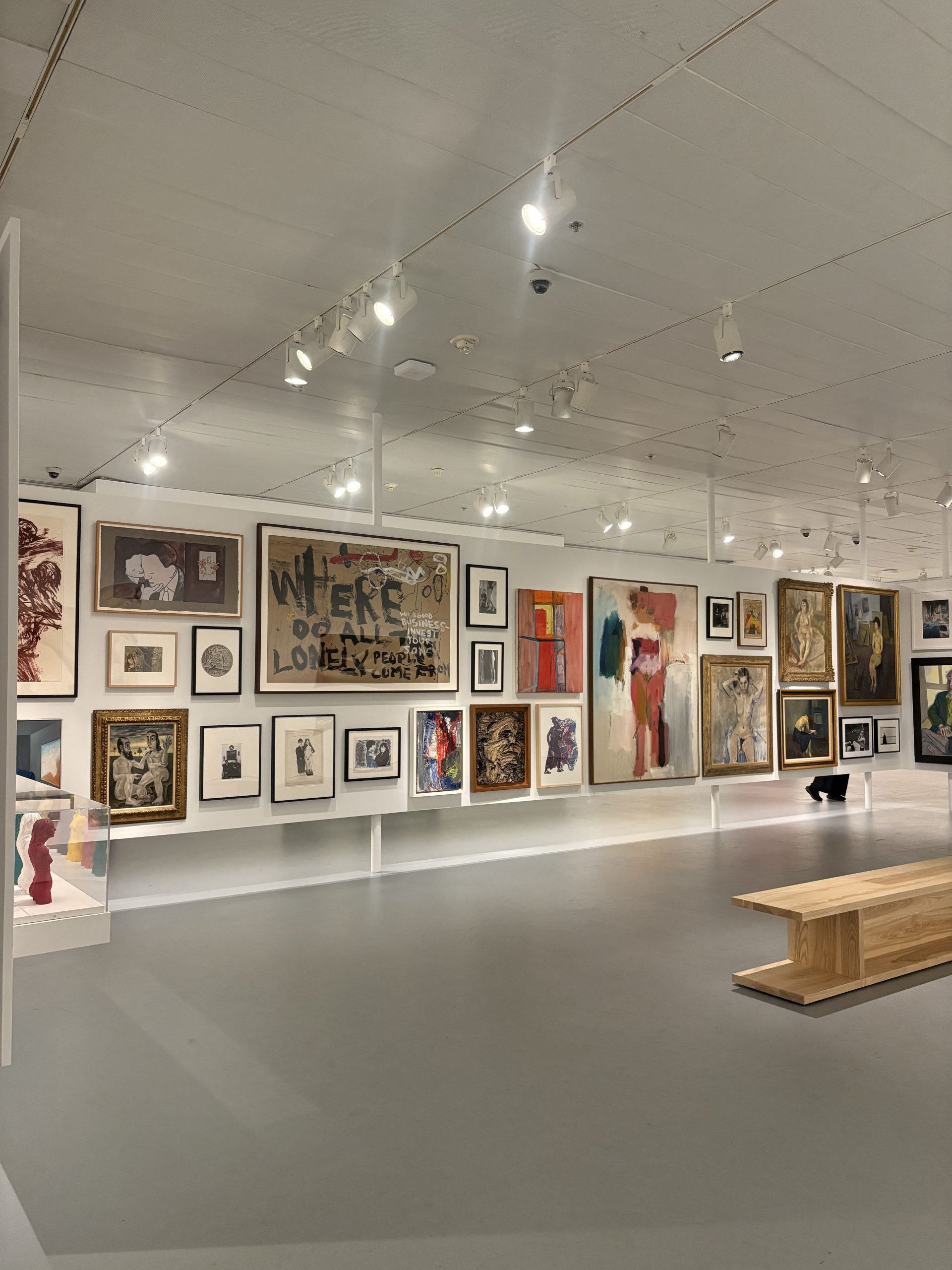
Installation view, Joan Semmel: In the Flesh, The Jewish Museum.
It would be unfair to miss the portion of this exhibition that consists not of Semmel’s own artwork, but a collection of artwork that she curated from the Jewish Museum’s collection. Among the selected works are pieces that similarly grapple with intimacy, gender, and the body, showcasing the artistic lineage inspiring and surrounding Semmel’s practice. This section of the show was especially playful and refreshing, to see a creative step outside of their own craft and into the role of curator. Through her selections, Semmel creates a thought-provoking display of both her inspirations and taste, offering context to better understand her work.
My personal favorite from this section was an etching and aquatint on paper by Israeli artist Benjamin Levy titled The Marriage (1970). Depicted are a man and a woman, seemingly on their wedding day. The man is clothed in a jacket, tie, trousers, and a dress hat, while the woman is completely nude. They stand below the printed title “The Marriage.” Alongside gender roles within marriage and the imbalance of exposure between men and women. something about it felt distinctly Jewish to me. Like much of the work that inspired Semmel, The Marriage (1970) resists easy interpretation, lingering in discomfort and ambiguity.
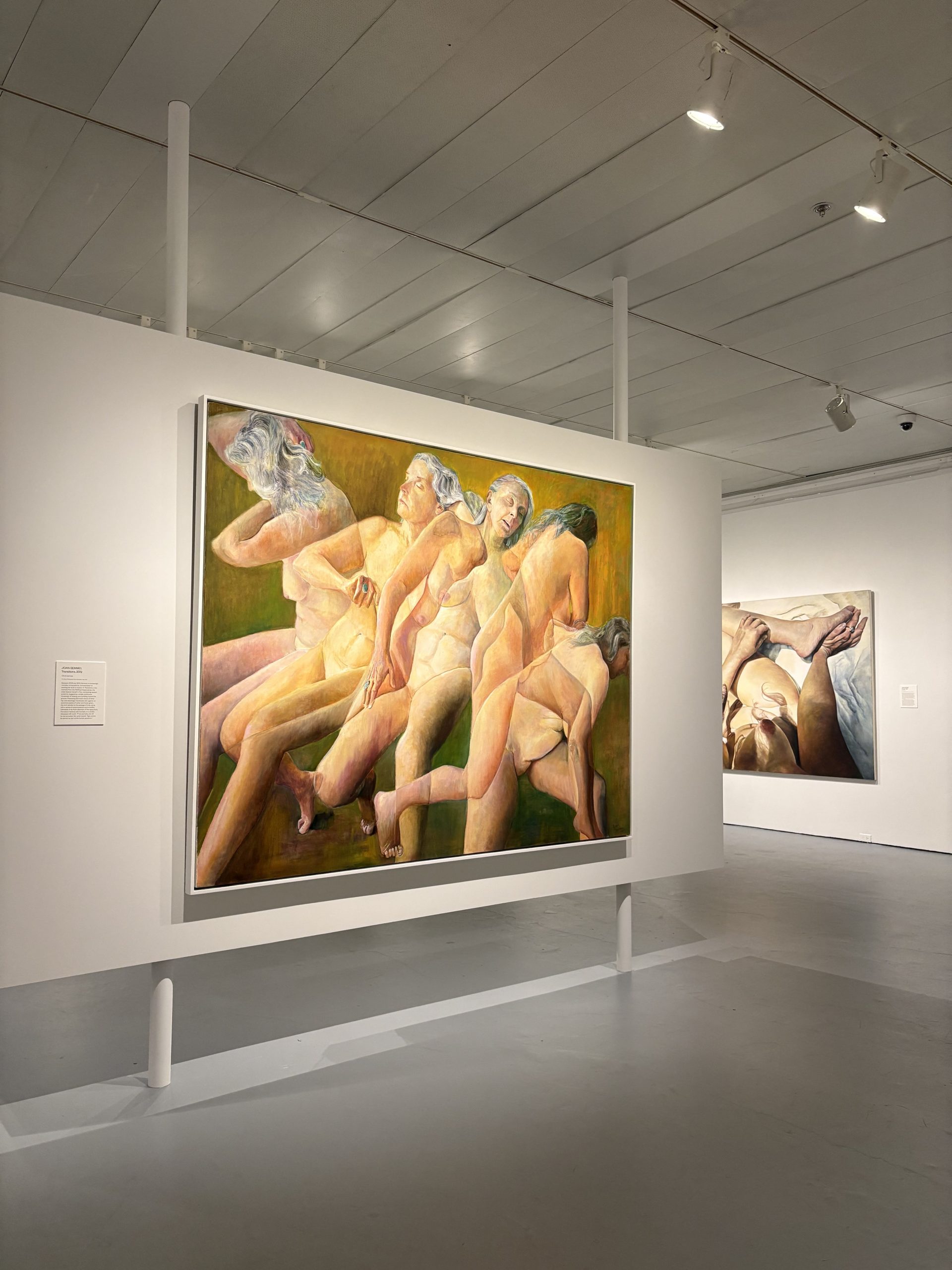
Transitions, 2012. Oil on canvas. Courtesy of Alexander Gray and Associates.
When I visited the exhibition with my parents, they suggested the show might benefit from a warning sign because of how graphic it is. After spending time with Semmel’s work, I began questioning why the unapologetic depiction of the female body is so often labeled vulgar. Discomfort surrounding images of the aging female body says less about Semmel and more about the limitations of the viewer. Society accepts endless idealized and sexualized images of women, yet recoils when confronted with bodies that are truthful and realistic.
At ninety-three, Joan Semmel continues to live and work in New York City, still producing some of the strongest work of her career. A recent Hyperallergic review described Semmel as making her best art at ninety-three, and I see this point wholeheartedly. Her paintings are bold, confrontational, and deeply confident. More importantly, they give visibility to bodies that art history has long ignored. Joan Semmel: In the Flesh ultimately transforms vulnerability into visibility, presenting the aging female body not as something to hide, but as something worthy of being seen.

Skin in the Game, 2019. Oil on canvas. Courtesy of Alexander Gray and Associates.


1 Comments
Laini Sweifach
What a well-written piece. This makes me want to go see all of Joan’s works. A great celebration of the artist.