
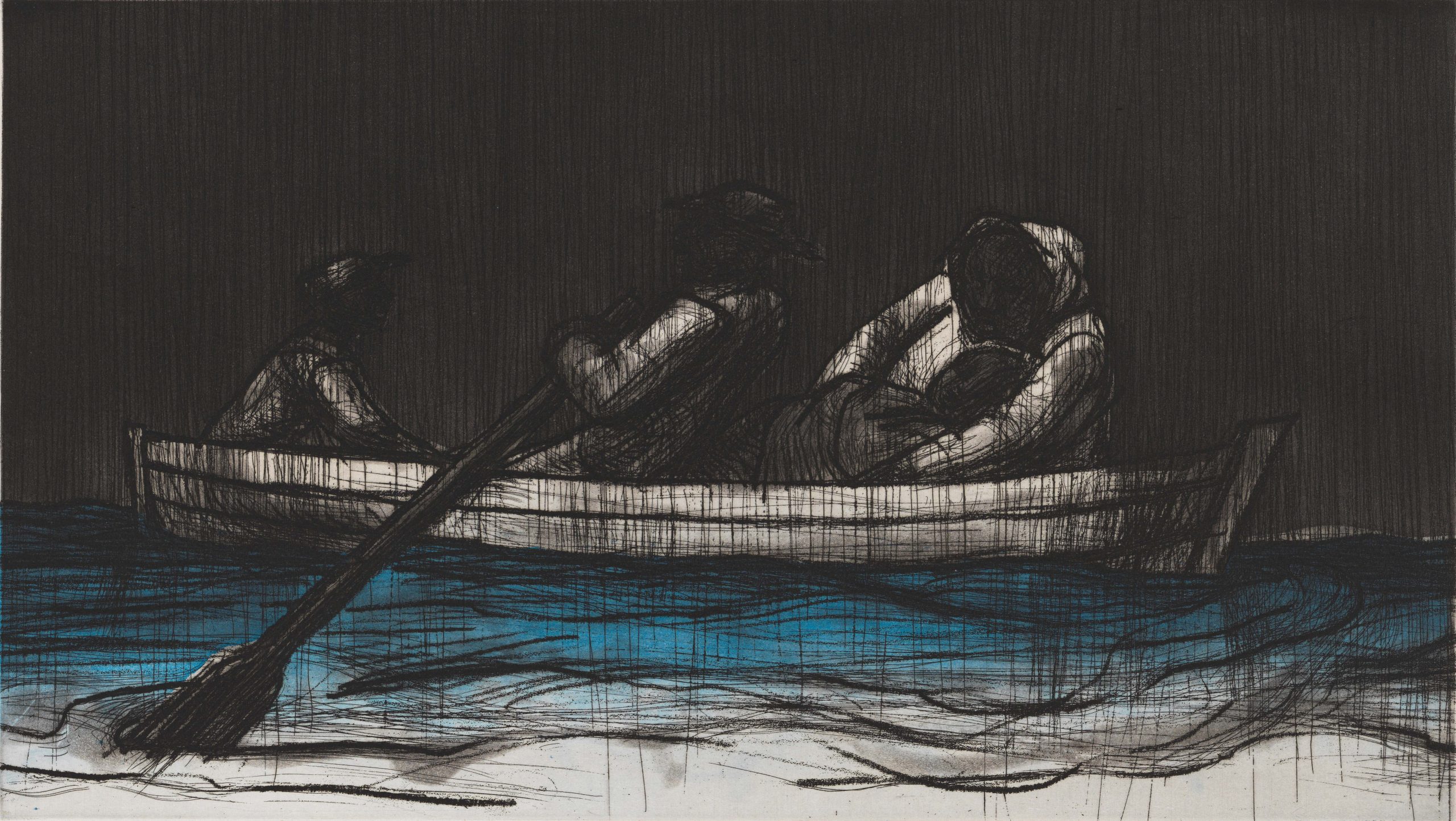
Journey of the Mann Family from “The Richard Wright Suite,” 2001. John Wilson, James Stroud, assisted by Keith Monda; Center Street Studio. Etching with aquatint, 12 × 16 in. (30.5 × 40.6 cm).(Courtesy: The Metropolitan Museum of Art).
John Wilson was an influential artist whose creative vision took shape across multiple disciplines. In essence, he was a lithographer, sculptor, painter, muralist, and art teacher. But perhaps most importantly, through his work, he became a powerful voice for social justice and equality in a world wrought with struggle and injustice. Through his work, he famously documented the contemptuous political climate of the time and the injustices he saw firsthand as a Black man in America when equality and social justice were still not a given. Central to his work are the themes of racial violence, labor, the writings of Richard Wright, the Civil Rights Movement, street scenes, and intimate images of family life, with a particular focus on fatherhood. Poetically, his artwork is only now being given the attention and reverence it so justly deserves.
Witnessing Humanity: The Art of John Wilson is the largest exhibition of this artist’s work. It is also his first solo museum show in New York. The exhibition is a collaboration, drawing from the collections of The Met, the Museum of Fine Arts Boston, and other lenders. The show features over 100 artworks from Wilson’s career, including paintings, prints, drawings, and sculpture, as well as illustrations for children’s books and archival material. Many of the works will be shown for the very first time.

Martin Luther King Jr., 2002 John Wilson, James Stroud, Center Street Studio. Etching and aquatint on chine collé. 36 × 30 in. (91.4 × 76.2 cm). (Courtesy: The Metropolitan Museum of Art).
“While the powerful impact of John Wilson’s art and the enduring relevance of the themes he explored are undeniable, he has not yet received the recognition his work so deeply deserves,” said Max Hollein, Marina Kellen French Director and Chief Executive Officer of The Met. “This landmark exhibition honors Wilson’s extraordinary achievements—illuminating the incredible range of work he produced over five decades—and affirms his place in art history as one of the foremost artists devoted to social justice and portraying the experiences of Black Americans.”
The exhibition encapsulates the artist’s full span of work throughout his lifetime, with the subject matter reflecting the ever-changing political and cultural landscape of the current time. Beginning with work he made while an art school student in Boston, his subjects included the racial violence in the US and the horrid conditions of Nazi Germany. Black Soldier, made two years after the United States entered World War II, conveys the indignities of the government forcing Black Americans to fight for freedoms in Europe while lacking their own freedom here in the US. Wilson said, “I was an idealistic young African American art student, struggling to find a way to express my fears and anger about the oppression of African American people in America. For me, the ruthless, efficient, invincible German storm troopers became a symbol of all-powerful forces of oppression, in which individuals were molded into collective killing machines, fueled by ideologies of hate and racial superiority.”
The time that the artist spent in Paris, Mexico City, and New York captures the humanity and breadth of his work. This work includes wrenching images of racist violence, workers’ rights movements, and an overall dissatisfaction with life. A notable painting, titled Black Despair, features a Black man hunched over a desk, his hands around his head in defeat. Wilson said of this work, “I drew scenes of the world around me which reflected the sense of alienation I felt as a Black artist in a segregated world.”

Streetcar Scene, 1945. John Wilson. Lithograph, 11 1/4 x 14 3/4 in. (28.6 x 37.5 cm). (Courtesy: The Metropolitan Museum of Art).
The exhibition concludes on a resonant and triumphant note with Wilson’s return to Boston and his focus on portraiture.. This is when the artist created two of his most recognizable works: a sculpture of Dr. Martin Luther King Jr. at the U.S. Capitol and a sculpture titled Eternal Presence. In the 1960s, he also began to create illustrations for children’s books, an activity that reflected his lifelong love of literature, as well as his desire to represent Black life.
Witnessing the evolution of his work throughout his life and through this exhibition, it’s clear that Wilson was personally witnessing both history and humanity. He sought to portray this idea of a universal humanity. Even at a young age, Wilson noticed the absence of positive representations of Black Americans on both small and large scales. Setting out as an artist, he aimed to create positive representations and make this central to his work. He once noted, “the implication was that Black people were not capable of being beautiful and true and precious . . . Black people and their special experience were irrelevant and unimportant.” Creating images of Black Americans with dignity and strength was paramount.
Exhibition co-curator and Jordan Schnitzer Curator in the Department of Drawings and Prints at The Met, Jennifer Farrell, said, “Wilson’s art is imbued with compassion and empathy while conveying his anger and distress at the wrenching effects of disenfranchisement, racism, and economic inequality. Challenging deep-seated prejudices and omissions within our national history, Wilson centered the experiences of Black Americans to create images that convey strength, resilience, and humanity. Deeply personal yet widely resonant, his work continues to offer a powerful lens through which to consider today’s urgent dialogues about race, equality, and representation.”
Wilson himself said his art depicted the “reality of being Black in this impossible world.” It was his lifelong aspiration to see the experiences and work of Black Americans like himself represented in museums. He curated many exhibitions himself for other Black artists in his lifetime. It’s now time to honor Wilson’s legacy and fulfill his own mission through his own exhibition. Witnessing Humanity is on view until February 8, 2026.


0 Comments