

Alexey Kononenko, The Book of Genesis, 2025. Exhibition view. (Courtesy: Alexey Kononenko & WILD Gallery, Jerusalem).
The wail of sirens pierces the darkness of an empty city. A light from a window falls onto the roof of the house across the street, casting a man’s shadow. He waves his hand, then closes the window, which is covered with black film, and begins scratching various holes into it, allowing dim light from outside to enter. The light forms letters that coalesce into a text.
Inside, hanging on the walls, some of the works are already finished: paper sheets, on which the artist repeatedly superimposed layers of black letters until the original text became illegible. The man is Alexey Kononenko, an artist and architect, and a member of the illustrious Iced Architects. His work, The Book of Genesis, is part of the recently opened exhibition at the WILD Gallery in Jerusalem.
WHAT: “Painful to Watch,” curated by Max Epstein
WHEN: through August 14, 2025
WHERE: WILD Gallery, Ahad ha–Am, 3, Jerusalem, Israel.
For twelve weeks preceding the originally scheduled opening, Kononenko was rewriting the story of Genesis— page over page, on his tablet — until the text became a single black digital monolith. But on the day of the exhibition opening, the 12-Day War broke out. Only on the third attempt was the exhibition finally opened for the public.
We’ve come to expect every artwork to be accompanied by a long explanatory text. Kononenko’s work is, in and of itself, a text—and a very mysterious one. Below is the interview with the artist, which just might help us understand the intent behind the darkness, the ritual of rewriting, and the meaning encoded in disappearance.

Alexey Kononenko, The Book of Genesis, 2025. Fragment. ( Courtesy: Alexey Kononenko & WILD Gallery, Jerusalem).
Misha:
The Book of Genesis, the first book of the Hebrew Bible and the Christian Old Testament, consists of 50 chapters, 1,533 verses, and 32,267 words in Hebrew. Its Hebrew name is Bereshit (בְּרֵאשִׁית), which means “In the beginning,” and matches the book’s first word. With your project, did you enter into a dialogue with the Beginning and declare an End?
Alexey:
Yes, and the 12 weekly sections, each containing roughly 12 pages with 20 lines per page.
Could the act of writing be called a dialogue? Could a text that creates the world ever have an end? But within that black blot are all 78,063 letters of the text.
Misha:
Copying sacred texts as a form of penance — a way of redeeming sins — is an old tradition in Christianity. But copying them as an artistic practice — is that your invention?
Was there something religious in this, like a self-imposed monastic obedience?
Alexey:
I haven’t heard of that tradition. Copying as punishment for sins? Strange. All I can say is — it’s a very pleasant activity; you just can’t stop. Especially, for some reason, on planes, as parts of the last two sections were written in the air. They were written over Tel Aviv–Tbilisi (on the night of Dec 31–Jan 1), Tbilisi–Moscow, Moscow–Yerevan, and Yerevan–Tel Aviv (on the night of Jan 12–13): above the Caspian, Black, and Mediterranean seas, the Pontic and Caucasus Mountains, Taurus and Ararat, Oka and Volga.

Alexey Kononenko, The Book of Genesis, 2025. ( Courtesy: Alexey Kononenko & WILD Gallery, Jerusalem).
Masha:
In today’s Russia, where we all made an exodus from, you can’t even touch a topic that might be considered religious. You now live in a very religious country. How is engagement with the sacred viewed in Israel?
Alexey:
Well, actually, I’m from Ukraine. There, religion has always been a lively and discussable topic, even in Soviet times. Walk through Lviv, for example: here are the Uniates, Greek Catholics; over there are the Christian Orthodox, with the service in Ukrainian; somewhere else—Russians, with services in Church Slavonic. Here’s the Armenian church; there—the Dominicans, and beyond them—the Jesuits (though in Soviet times, those churches were repurposed as gyms or museums of atheism), lots of sects too, especially in Crimea. Is there a difference? Turns out—yes. And everyone knows it.
In Israel, faith is not what we are used to. Here, it’s less about free choice and more about tribal or clan identity. I wouldn’t even call Israel a religious country, although its very existence rests on a religious foundation. Outside of the biblical promise, Jews have as much claim to this land as the Roma to India, or the Armenians to Ararat.
It’s paradoxical, but the ultra-religious population here is often anti-Zionist, while the secular population—indifferent to the biblical covenant—serves in the army and keeps the country going. However, there are many religious Zionists who serve in the military, too. Like most societies today, Israelis are divided roughly in half between religious and secular.
Nonetheless, the sacred is abundant here, even in secular life, and everyone, to some degree, interacts with it. For example, on every doorframe—even at train stations and government offices—there’s a sacred amulet: a mezuzah, and people touch it as they enter, without consequences.
By the way, inside every mezuzah is a tiny parchment scroll, written in sacred script with a bird-feather quill. No printing and paper allowed —only parchment from animal skin. I am not aware of any other country where such archaic traditions are as fully integrated into daily life.
Masha:
What’s allowed for an average person can cost an artist dearly. I meant religious themes in contemporary art. Are there taboo topics in Israeli art?
Alexey:
Are there any taboo topics in European contemporary art?
I think the prevailing discourse here in modern art is moderately secular-left, with feminist optics. The ideal author is an Arab woman artist integrated into Jewish secular society, working on issues related to gender equality.
Copying sacred texts is unlikely to be part of the mainstream—it has its niche in another sector. This is why, in part, I found this project interesting: to bring archaic practices into the modern media and digital space. But it’s unlikely to offend religious sensibilities—just as it’s unlikely to garner serious attention from art institutions.
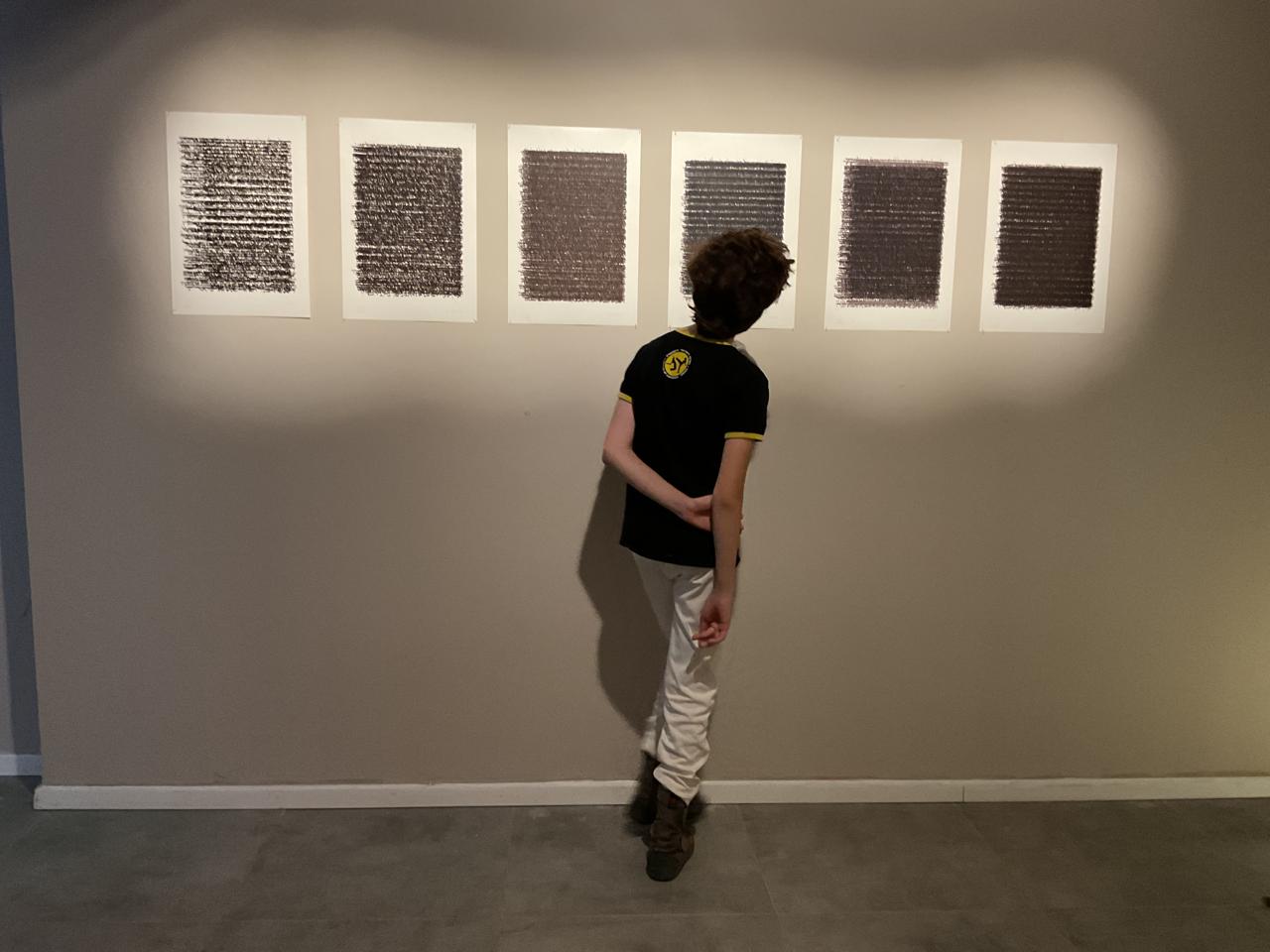
Alexey Kononenko, The Book of Genesis, 2025. Exhibition view. (Courtesy: Alexey Kononenko & Wild Gallery, Jerusalem).
Masha:
In the early 20th century, an artist drew a portrait of his teacher on his deathbed in black ink. Following the teacher’s philosophy, the artist attempted to unite and connect everything. He united it so much that the drawing turned into an almost indiscernible black blot. When I heard that story, I suddenly understood — Malevich’s Black Square isn’t “nothing” — it’s everything! Everything in the world is so united and interconnected — there are simply no gaps left!
In a 2003 interview, you said, “God did not create the world by erasing, but by setting boundaries. He separated light from darkness, day from night. When we speak of a ‘world without borders’, we are destroying the world.” And in this work, you fused the boundaries of letters into a single space in one text, but in another, you made holes between inner and outer space. Yet now we’ve all had to reconsider boundaries—in every sense: moral, geographic, personal.
So, which is it — unity or separation?
Alexey:
Self-restraint or limitation? Both.
When that interview was recorded, “a world without borders” was an indisputable slogan of peace, progress, and freedom. A significant amount of water has gone into the Dead Sea since 2003, but it continues to dry up. It is said, “He separated light from darkness, the sacred from the profane, Israel from the nations, the seventh day from the six.” In the country where I live now, separation is a condition for survival. If there’s a breach in the fence somewhere, a tragedy occurs, and chthonic forces invade life, like depressurization in outer space. That is Israel, where hell and paradise are mixed. Nothing to be done — it’s the Holy Land.
By the way, “chthonic” is from Greek’s ‘earth’ or ‘soil,’ while in Hebrew, kadosh — means “set-apartness” and ‘separateness,’ as well as ‘holiness’ and ‘sacredness.’ It is also said, “The Torah is written with black fire on white fire.” What does that mean? I don’t know — but it sounds rather digital: signal/no signal, 0/1. So, unity and separation are not antagonistic or mutually exclusive: one might recall Great Separation (大分, Dà Fēn) — a cosmological concept in early Chinese philosophy that refers to the primordial moment of division between heaven and earth, or more abstractly, the separation of unity into duality, marking the beginning of the cosmos as we know it. Its opposite would be disorder—perhaps, Great Disorder.

Alexey Kononenko, The Book of Genesis, 2025. (Courtesy: Alexey Kononenko & WILD Gallery, Jerusalem).
Masha:
There’s a formula for good artwork: “There’s more at the output than at the input.”
In your case, besides what some noted, your work’s real density and impact, Arabic letters appeared in the spacing. What do they say?
Alexey:
Yes, as the spaces between the lines filled up, other scripts began to appear — white on black.
Are they Arabic or Aramaic in Syriac script? Not sure. At first glance, it looks like Kufic script, but I’m no expert. So far, the interlinear text hasn’t been deciphered. Maybe it’s a lost ancient layer — or a message from the future.
Misha:
Do these Arabic characters appear and disappear in lacunae with the increased density of the original text?
In the end, does a solid black monolith remain? Is it like the logos that vanishes from the stream of thought during meditation?
There’s also an allusion to Malevich’s Black Square and the transience of earthly life in human terms. How long is the video itself? Does the duration allotted to a viewer hold any meaning?
How are the pages arranged in your “non-disappearing text,” since the original was written on a scroll? Did you think about this shift from scroll to codex?
Alexey:
Yes. And again—yes. Exactly that. And yes, both allusions are present. The duration doesn’t matter much — it depends on context. Online, each video is no longer than two minutes; at the exhibition, it is about half an hour. All 12 videos are not that different — just various combinations of marks and hooks, the same thing, more or less. The colossal labor of world-creation is not flashy.
As for my work, “The Book of Genesis”, its essence lies in the process. Writing – not as a given, not as a “script,” but as a process — a “writing.” Initially clear, the text becomes increasingly indistinct until it turns into a black blot. Writing as a way of creating a world that shifts toward indistinguishability. That’s why the exposition is arranged like a storyboard: with each sheet, a new layer is added, and the final “black rectangle” merely concludes the sequence. And it’s not even a true rectangle — along its edges, one can still discern the letters it’s composed of. Hence, the video projection shows the process of writing.
Writing is the opposite of reading, and the written text is far too well-known for it to be read again.
The scroll versus codex — that’s a subject I’ve been preoccupied with for years. The same text, when presented via these two different media, is perceived differently and conveys different meanings.
There is a saying: “to know Scripture to the needle,” which means mentally piercing the scroll with an imaginary needle, and the one who does know, knows which letters, from which sections, that needle pierces.
But this project is limited to one sheet—it’s neither a codex nor a scroll, or maybe it’s both. A scroll is a very long sheet with a lot of text, rolled into a log. A codex is a stack of sheets with the same text, like a brick.
Here, we’re looking at just one page.

Alexey Kononenko, The Book of Genesis, 2025. (Courtesy: Alexey Kononenko & WILD Gallery, Jerusalem).


0 Comments