
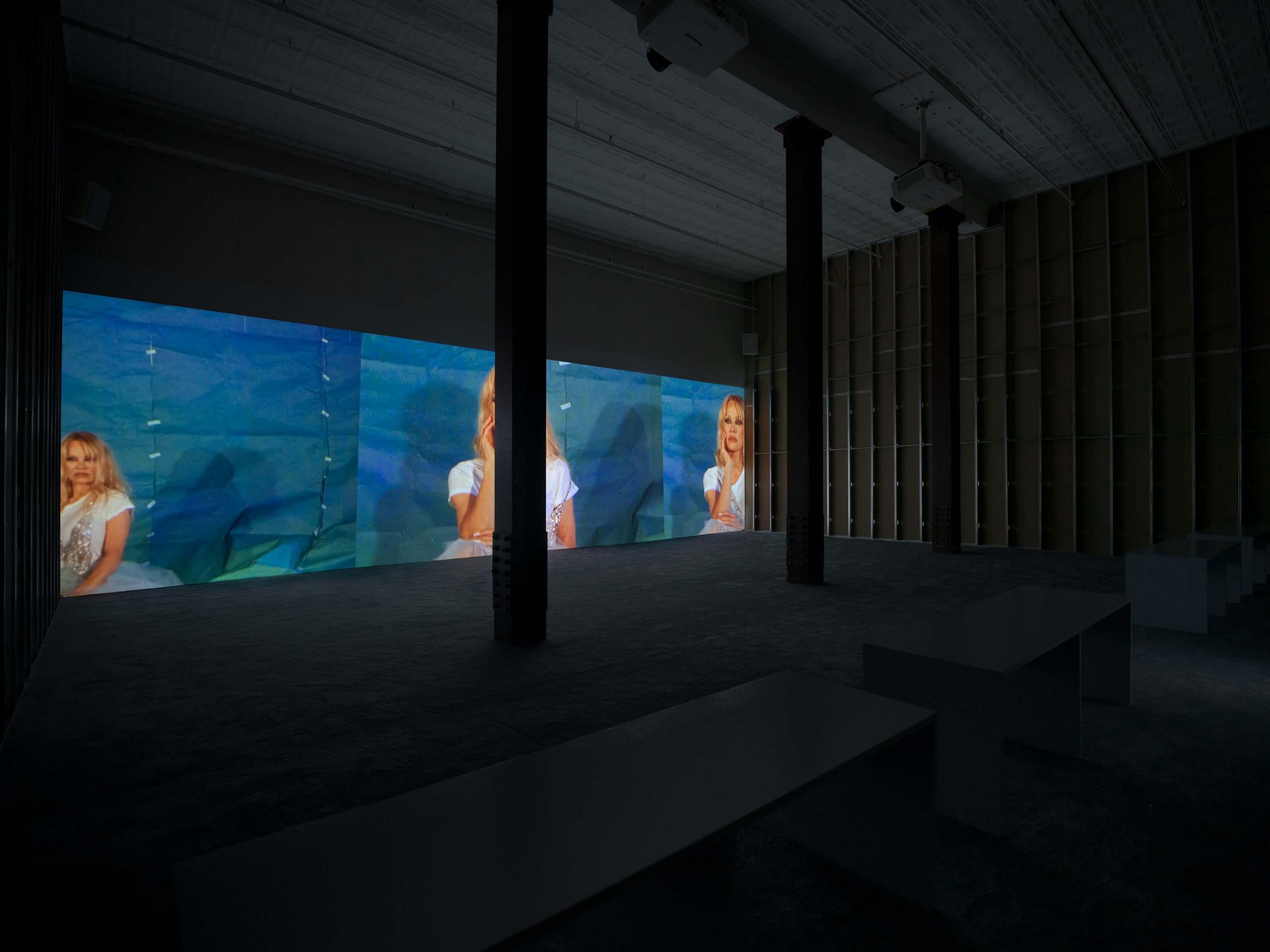
Sara Cwynar, Baby Blue Benzo, 2024. Anamorphic video projection, digital video and 16mm film transferred to video. (Courtesy: the artist and 52 Walker).
Living in New York City, where many residents rely on our (often unreliable yet still essential) public transportation system to get around town, it can be easy to forget that most other Americans need cars to transport themselves. Thus, one could also forget that for some Americans, a car is more than just a practical means of transportation; it is also potentially a status symbol as well. That’s one of the starting points for Baby Blue Benzo, the latest film/installation from the Canadian-born, Brooklyn-based multidisciplinary artist Sara Cwynar, which recently concluded a run at the 52 Walker Gallery in New York.
Objects as markers of status is certainly a subject Cwynar knows well. I’ve written about her work once before, in the context of Marilyn, an art installation that she migrated online in 2020 during the COVID-19 lockdown. The centerpiece of Marilyn was a 13-minute short film titled Red Film, which I described in part as “a coherent commentary on the vicious cycle of capitalism which, with the aid of modern media, perpetrates our physical insecurities” and “the work of an artist who has clarified her obsessions.” Turns out, Cwynar has even more to say on that broad subject with the even longer (22 minutes) Baby Blue Benzo, which doesn’t so much take her obsessions in different directions as extend them further back in history and deeper in personal and philosophical depth.
And I do mean “personal” because, for once, Cwynar, to some degree, foregrounds the very personal genesis of this latest project. “It started because I couldn’t sleep,” utters voiceover narrator Paul Cooper at the very beginning of the film, referring to the bout of insomnia that fueled her ensuing obsession with classic cars—including the 1955 Mercedes-Benz 300 SLR that half-inspired the film’s name—and their implicit societal status. (The other half-inspiration is benzodiazepines—medications often used to treat insomnia and other such conditions.) Unlike in her previous films, though, Cwynar also injects herself into this one, sharing vocal duties with Cooper in her typically heady and aphoristic narration and including shots of herself posing and interacting with cardboard-cutout versions of cars. In a sense, she’s transcending, if not entirely erasing, her usual intellectual detachment from the objects and advertisements she utilized and analyzed previously.

Self-portrait by Sara Cwynar. (Courtesy: the artist and 52 Walker)
But of course, Cwynar is very much of the millennial generation, with the lightning-fast dissemination of images made possible by the Internet, especially social media. In such an age, when digital products are becoming more pervasive than physical ones, maybe it’s enough to just have seen and saved a desired image of something instead of actually plunking down money to own it. Such a proposition has been a cornerstone of Cwynar’s art from the very beginning, with its horizontal-scrolling approach to showing scads of advertising imagery and the rapid-fire pace with which it’s presented. What’s new about Baby Blue Benzo is the extent to which Cwynar implicates herself in that kind of surface consumption: how’s she as seduced by the surface as everyone else.
That greater ambition is reflected not just in its length and the much wider film frame she’s working with this time around—with the screen’s two channels adding up to something like, say, the 1959 Hollywood epic Ben-Hur‘s 2.76:1 frame—but also in what appears to be its larger budget. At the very least, Baby Blue Benzo even has something of a celebrity cameo in it: Pamela Anderson, of whom Cwynar did a photo shoot for an article in the New York Times in 2023, and who was to sexual desire in the ’90s what the aforementioned Mercedes-Benz was to conspicuous consumption in the ’50s. Plus, the film’s moments of breaking the fourth wall—in which we see Cywnar and her crew on a set taking 360-degree shots of models next to cardboard-cutout cars—is a fresh technique in her arsenal.

Sara Cwynar, Baby Blue Benzo, 2024. Anamorphic video projection, digital video and 16mm film transferred to video. (Courtesy: the artist and 52 Walker).
Portraits of Anderson also lined some of the walls of the film’s accompanying exhibition, which also included one of Cwynar’s portraits of her. Though some of the other artworks in the exhibition merely encapsulated visual motifs in the film (including an arguably too on-the-nose image of a slab of meat in an art studio), the exhibition as a whole was hardly just an also-ran. Most memorably, there were canvasses of whole wardrobes created out of cut-outs from paper ads that strengthened the film’s overriding thesis of people assembling their own brands from off-the-shelf parts, that shelf being the vast repository of images and ideals pushed by advertising companies and societies at large.
Ultimately, though, it was the film itself that mattered most: Cwynar’s broadest, most ambitious, and arguably finest work yet. Here’s hoping that its most recent exhibition at 52 Walker isn’t the only way you’ll be able to see the latest from our most noteworthy living chronicler of consumerism and image obsession in our plugged-in, social-media-savvy age.


0 Comments